The Most Excruciating Pain Known to Medicine? Understanding Trigeminal Neuralgia

By: Pawan Krishna Murti
The Anatomy of the Trigeminal Nerve: The Main Sensory Nerve of the Face
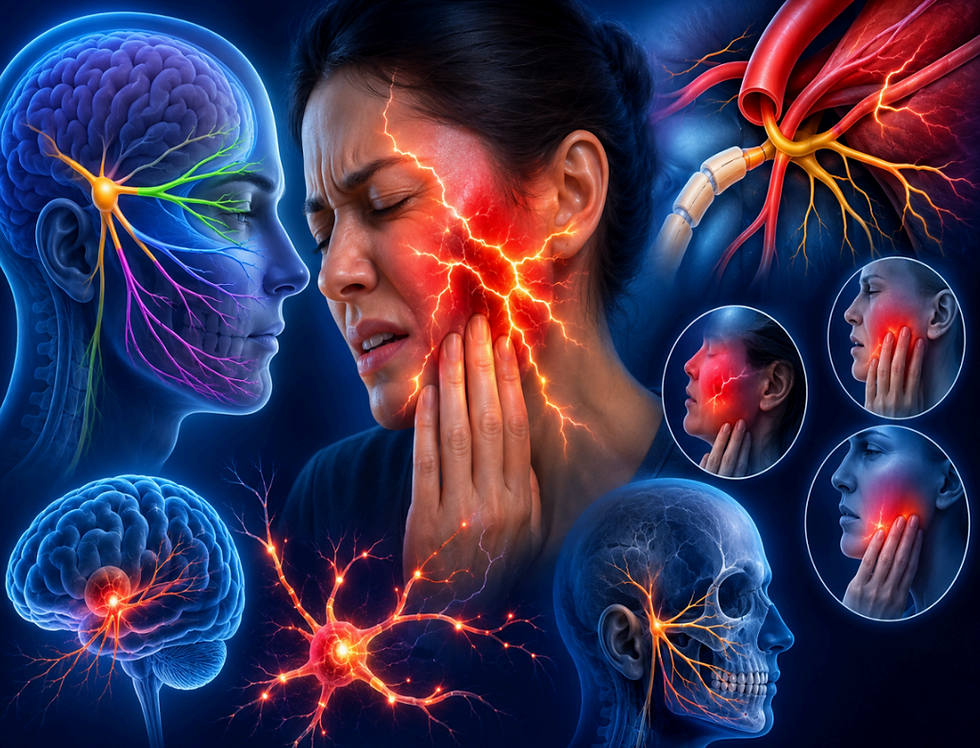
The trigeminal nerve (cranial nerve V) is the largest of the twelve cranial nerves and serves as the principal sensory nerve of the face. Its primary function is to transmit sensations such as touch, pain, pressure, and temperature from the face to the brain. In addition, it provides motor innervation to the muscles involved in mastication (chewing).
The trigeminal nerve is divided into three major branches:
Ophthalmic Division (V1): Supplies sensation to the forehead, scalp, upper eyelid, and eyes.
Maxillary Division (V2): Supplies sensation to the cheeks, upper jaw, upper teeth, nose, and upper lip.
Mandibular Division (V3): Supplies sensation to the lower jaw, lower teeth, chin, and part of the tongue. It also controls the muscles responsible for chewing.
Together, these three divisions provide sensory innervation to nearly the entire face and oral cavity, playing a crucial role in facial sensation and normal oral function (1).
What Is Trigeminal Neuralgia?
Trigeminal neuralgia is a chronic pain disorder that affects the trigeminal nerve. It is characterized by sudden episodes of severe facial pain that may feel like an electric shock, stabbing sensation, or intense burning pain. The attacks are usually brief, lasting from a few seconds to a few minutes, but they can occur repeatedly throughout the day. The pain most often affects one side of the face and commonly involves the upper or lower jaw. Because of the intensity of the pain, trigeminal neuralgia is often considered one of the most painful
conditions known in medicine (1,2).
What Causes Trigeminal Neuralgia?
In many cases, the condition occurs when a nearby blood vessel presses against the trigeminal nerve close to where it enters the brain. Over time, this pressure can damage the nerve's protective covering, known as myelin, causing the nerve to send abnormal pain signals. Less commonly, trigeminal neuralgia may be associated with conditions such as multiple sclerosis, tumors, or other disorders affecting the nervous system. In some individuals, no clear cause can be identified (1, 3).
Symptoms
People with trigeminal neuralgia may experience:
● Sudden, severe facial pain
● Electric shock-like sensations
● Stabbing or shooting pain
● Pain triggered by everyday activities
● Periods without pain between attacks
Even simple actions such as brushing teeth, washing the face, talking, smiling, shaving, eating, or exposure to a light breeze may trigger an episode (1).
Impact on Quality of Life
The unpredictable nature of the pain can have a significant impact on daily life. Many people begin to avoid eating, speaking, or social interactions because they fear triggering an attack. Anxiety, depression, sleep disturbances, and reduced quality of life are common among affected individuals (1,4).
Treatment Options
The first step in treatment is usually medication. Drugs such as carbamazepine and oxcarbazepine are commonly prescribed because they help reduce abnormal nerve activity.
Other medications that may be used include:
● Gabapentin
● Pregabalin
● Lamotrigine
● Baclofen
For patients who do not respond adequately to medication, surgical procedures may be considered. Some procedures aim to relieve pressure on the nerve, while others interrupt pain signals traveling along the nerve (1,5).
Looking Ahead
Research continues to improve our understanding of trigeminal neuralgia and the mechanisms that cause facial pain. New therapies are being developed that target specific nerve pathways and may provide more effective pain relief with fewer side effects (4).
Conclusion
The trigeminal nerve is essential for facial sensation and normal oral function. When this nerve becomes damaged or irritated, it can lead to trigeminal neuralgia - a condition marked by sudden and severe facial pain. Although the disorder can be life-altering, advances in diagnosis and treatment offer hope for better symptom control and improved quality of life for affected patients (1).
References
1.Gambeta E, Chichorro JG, Zamponi GW. Trigeminal neuralgia: An overview from pathophysiology to
pharmacological treatments. Mol Pain. 2020;16:1744806920901890. doi:10.1177/1744806920901890. Available
2.Kingwell K. Nav1.7 withholds its pain potential. Nat Rev Drug Discov 2019; 18: 321–323. doi:
10.1038/d41573-019-00065-0. Available from: https://pubmed.ncbi.nlm.nih.gov/31048807/
3.Liu Y, Tanaka E. Pathogenesis, diagnosis, and management of trigeminal neuralgia: A narrative review. J Clin Med.
2025;14(2):528. doi:10.3390/jcm14020528. Available from: https://doi.org/10.3390/jcm14020528
4.Wei, X.; Zhou, H.; Zhang, S.; Hu, X.; Wei, Z.; Li, Y. A comprehensive two-sample Mendelian randomization analysis
of trigeminal neuralgia and modifiable risk factors. Front. Neurol. 2023, 14, 1292958. Available from:
5.Anwar, H.A.; Ramya Krishna, M.; Sadiq, S.; Ramesh Kumar, R.; Venkatarathnam, V.; Saikiran, G. A study to evaluate
neurovascular conflict of trigeminal nerve in trigeminal neuralgia patients with the help of 1.5 T MR imaging. Egypt. J.
Radiol. Nucl. Med. 2022, 53, 66 Available from :https://link.springer.com/article/10.1186/s43055-022-00746-8