


The Patient Experience
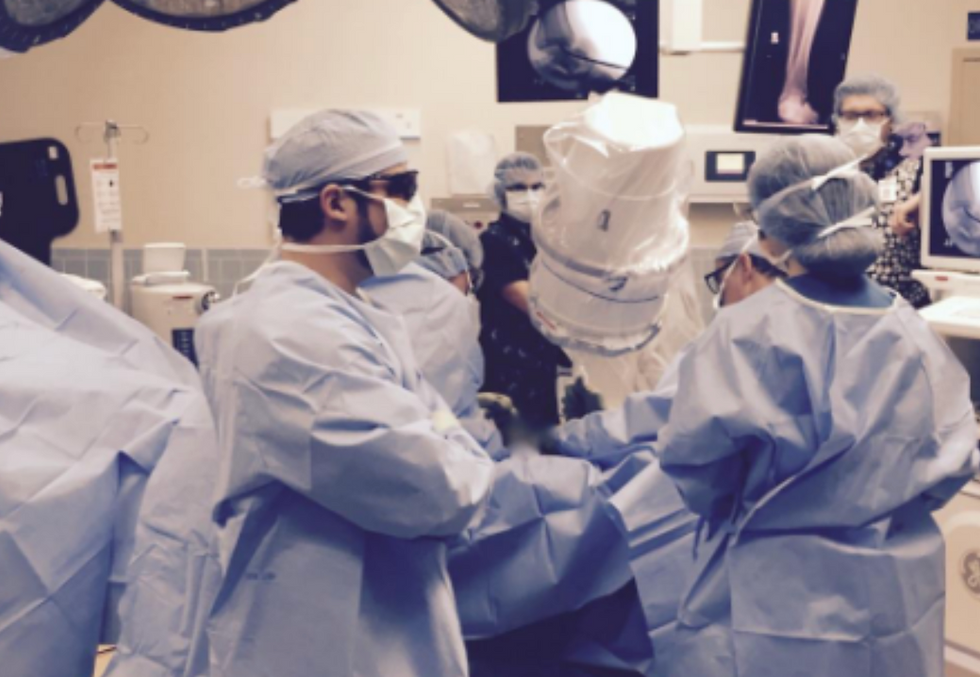
Like an airport taxi way, several carts with patients exited pre-op one after the other. Stark hallways gave way to the operating theater doors and the carts split off; left, and right.. The cotton blanket surrendered its warmth almost immediately. Near the end of the hallway, the cart spun around, head-first, and rolled through the doors of OR 4.
The room was cold. Forewarned, yet still surprising.
Hustle ensued, a choreographed precision. The OR nurse swapped the blanket with practiced efficiency, warm side on top then quickly flipped over, now against the skin. The cart was narrow until the shimmy onto the OR table, which was narrower still and a hasty internal calculation about whether all the body bits would fit. A brief lull, time to take stock. Faces looked down from an unfamiliar angle. A lot of chins. Notifications chattered before arm boards were attached, both arms secured, swept out to 90 degrees. Pinned and still, the only comfortable view is up.
Three large mirrored discs reflect back the patient looking up; mounted on articulated arms, positioned for everyone in the room except the person lying still. The anesthesia provider is speaking, soft and kind. The patient wonders if it's too late to reconsider the surgery. Medication. Left arm. Futile resistance. Sleep. No chance to count backward like the movies.
What the Patient Never Sees
The OR table is engineered for surgical access and patient safety, not the experience of lying on it (1). It allows the surgical team to stand close to the operative field from both sides, reduces physical strain during long procedures, and allows imaging equipment, when needed, to move freely. Patients are never as vulnerable as they are on that table. The circulating nurse isn't reacting to problems; they're actively managing the conditions that prevent them. Continuous awareness of the surgical and anesthetic picture means the team can focus entirely on the patient (2).
The overhead lights may surprise you. They’re technologically advanced, and designed to reduce shadows (3). This ensures the surgical field remains illuminated even when the surgeon’s hands or instruments are in the way. OR lights are designed to mimic colors accurately which allows surgeons to distinguish between tissue types and anatomical structures (3). Ironically, despite all that bright light and sophisticated technology, the question patients ask most often: Why is the room so cold?
Positioned under hot lights, wearing non-breathable gowns, surgical hats, and gloves, the team generates significant heat quickly. Add equipment venting warm air into a small enclosed space and humidity becomes a concern. A surgeon sweating over an open wound is not what you want (4).
Temperature Control
Thermoregulation is a patient safety issue with significant side effects associated with hypothermia; becoming too cold. This carries risks including increased bleeding, impaired wound healing, and cardiac stress (5).
Once under anesthesia, a medical grade inflatable device circulating warm air directly against the skin maintains core temperature throughout the procedure. Warm intravenous fluids and warmed wound irrigation complete the strategy (5).
The cold room and a warm patient aren't contradictions. They're a coordinated system.
The Other Side of the Table
I was a perioperative nurse for over 10 years before I had abdominal surgery. Understanding the intricacies of why the room is cold didn't help when I was the patient being wheeled in head first. Feeling the chill wrap around my fear like an ice to a pole. Seeing people I worked with side by side, but never noticing their chins until I was looking up at them. As the patient, the room looked enormous. As a nurse it was cramped. The OR table I'd worked beside for years felt narrow in a way it never had before. In the end it's the room your surgical team lives in every day. For the patient, it's a strange and scary land. For the clinical team, every decision in that room is made with you in mind.
References
1. Bentsen SB, Eide GE, Wiig S, Rustøen T, Heen C, Bjøro B. Patient positioning on the operating table and patient safety: A systematic review and meta-analysis. J Adv Nurs. 2025;81:5585–5602.
2. Samost-Williams A, Brook K. Using Safety I, II, and III to level up patient safety. Curr Opin Anaesthesiol. 2025;38(6):741–747.
3. Curlin J, Herman CK. Current state of surgical lighting. Surg J. 2020;6:e87–e97. https://doi.org/10.1055/s-0040-1710529
4. Katz JD. Control of the environment in the operating room. Anesth Analg. 2017;125(4):1214–8. https://doi.org/10.1213/ANE.0000000000001626
5. McSwain JR, Yared M, Doty JW, Wilson SH. Perioperative hypothermia: Causes, consequences and treatment. World J Anesthesiol. 2015;4(3):58–65. https://doi.org/10.5313/wja.v4.i3.58
Assessed and Endorsed by the MedReport Medical Review Board

