Will Robots and AI replace surgeons?

As AI becomes increasingly apparent in everyday tasks and continues to advance, the question of how it will revolutionize healthcare has become clear. To define AI (artificial intelligence), it is the study of algorithms that give machines problem-solving abilities, such as visual perception, word recognition, and making predictions based on inferences.

AI and robotics can be used in a number of ways when it comes to surgery and operations. Before surgery, AI algorithms can be used to predict issues, create 3D models, and serve as a diagnostic imaging tool. 3D models are particularly important because they can help surgeons better prepare for a patient's surgery based on their specific MRI/CT scans. In operation, AI can be used to enhance surgery precision, such as removing tremors. Robotics can also be used to perform simple surgical tasks such as knot tying, suturing, and closing a port site. AI can even be used post-surgery, specifically through wearable sensors, which can help monitor a patient's vital signs and send alerts to providers/healthcare workers if something has gone wrong.
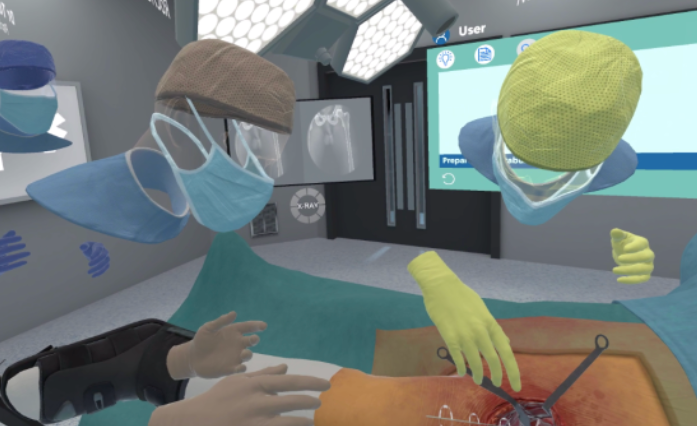
Outside of just surgery, AI has been used to improve surgical training as trainees can attempt more complex procedures through simulations and virtual reality without the risk of harming a patient. AI has also been used to make health systems and hospitals more efficient and to reduce costs. A common way AI has done this is by estimating how much time is left in a surgery.

The healthcare fields that AI has affected the most have been dermatology, pathology, and radiology. This is because AI is most frequently used when identifying patterns, detecting objects, and classifying images. A study has even shown that through using AI, pathologists have reduced the error rate when recognizing lymph nodes that are cancer positives.
A potential downside of AI and robotics systems, because they are continuously used for surgical tasks, is that trainers may no longer need to learn simple abilities (suturing, tying knots) because the AI will likely beat them in precision. There has also been an increase in concern about who holds responsibility if surgery goes wrong. Many have come to the consensus that the physicians are still held accountable, as they are the ultimate decision makers.
At the end of the day, AI is supposed to assist surgeons rather than completely replace them. Through robotics surgery, surgeons can actually become a lot more confident, careful, and focused in their decisions, which will ultimately lead to better patient outcomes.
Works Cited
Breeding, Emily. “Future of AI in Surgery - Association for Academic Surgery (AAS).” Association for Academic Surgery (AAS), 27 Jan. 2026, www.aasurg.org/future-of-ai-in-surgery/.
McCartney, Jim. “AI Is Poised to “Revolutionize” Surgery.” ACS, American College of Surgeons, 7 June 2023, www.facs.org/for-medical-professionals/news-publications/news-and-articles/bulletin/2023/june-2023-volume-108-issue-6/ai-is-poised-to-revolutionize-surgery/.
“Using AI in Surgery: 7 Benefits and 5 Considerations.” Carrum Health, 21 Aug. 2025, carrumhealth.com/blog/the-growing-presence-of-ai-in-surgery/.
Assessed and Endorsed by the MedReport Medical Review Board