


Why the Outside of Your Hip Hurts: Understanding GTPS

Greater trochanteric pain syndrome (GTPS), formally known as gluteal tendinopathy, is a common condition involving the muscles, tendons and other anatomical structures surrounding the hip. GTPS occurs in 1/300 people annually, affecting mainly middle-aged women or athletic individuals. It is characterised as pain over the greater trochanteric area, situated on the outer area of the hip, which is exacerbated by prolonged sitting, climbing stairs, high-impact activity or lying over the affected area.
Why Hip Anatomy is important to GTPS

To understand GTPS, it helps to first understand the anatomy of the hip area.
There are several important muscles and tendons that work together to keep the pelvis stable during everyday movements such as walking, climbing stairs and running.
The two key muscles involved are the gluteus medius and gluteus minimus. These muscles are involved in hip abduction. They are a part of a group of muscles called the glutes and attach to the outer part of the thigh bone (the greater trochanter) with tendons. These tendons anchor the muscles to the bone. The greater trochanter is often the most common site of pain for individuals with GTPS.
The Tensor Fasia Latta (TFL) lies over the gluteus medius and gluteus minimus and inserts into the large band that runs along the side of the thigh bone to the knee, known as the Iliotibial band (ITB).
Surrounding the hip bone are several bursae. These are fluid-filled sacs that act as cushions between bones, tendons, muscles, and skin near joints.
How Tendon Problems Develop
Problems arise when tendons are subjected to stress beyond their maximum capacity. This is called tendon overload. Examples include: repetitive activities, sudden increases in exercise, prolonged standing on one leg and long periods of pressure on the outside of the hip, such as lying on one side. If the tendon does not recover properly after being overloaded, it can become irritated and weakened, a condition formally known as tendinopathy.
Tendon Pathophysiology

Healthy tendons are composed of an organised extracellular matrix (ECM), rich in type 1 collagen fibres and special proteins. Controlled loading (weightlifting, machine exercises, dumbbells, bodyweight, etc.) and an appropriate amount of exercise lead to microtrauma, which increases type 1 collagen production, allowing for an overall increase in tendon diameter and density and creating stronger tendons. This loading aligns collagen fibres in a parallel pattern for structural integrity and efficient force transmission. In tendinopathies, however, balance is disrupted. Repetitive activity or excessive loading leads to inflammation that triggers enzymes responsible for the break down of the ECM . An increase in inflammatory molecules and enzymes trigger pain signals, which result in pain symptoms experienced during GTPS. The rise in inflammatory markers reduces the production of type 1 collagen and results in the production of type 2 and 3 collagen fibres that are thinner and weaker. At the same time, abnormal mechanical signals cause collagen to be deposited in random orientations. Consequently, a structurally weak tendon is produced.
Muscle Balance and Load Sharing
Hip muscle strength plays a major role in how much stress the gluteal tendons are subjected to. When the gluteus medius or minimus is weaker on one side or not working efficiently, other structures around the hip have to take on extra load. When the ITB (a thick band of connective tissue that runs down the outside of the thigh) compensates for this gluteal weakness, pain can extend beyond the greater trochanter and follows the ITB further down the lateral aspect of the thigh.
A person with GTPS may also see further changes in muscle imbalance. The gluteal muscles can become weaker, while muscles at the front or side of the hip become tighter or overactive. This imbalance places additional strain on the tendons and can make recovery more difficult if not addressed.
The Bursa
Previously, GTPS was thought to occur as a result of bursitis, inflammation of the bursa. Imaging scans from people with GTPS have sometimes shown excessive fluid around the outer hip, indicating an inflamed bursa. However, current research suggests that this fluid is a reaction to the underlying tendon irritation rather than the cause of the pain itself. In most cases, tendon changes are primary, whilst the bursa responds secondary.
GTPS is More Common in Women
GTPS occurs more frequently in women than in men, due to differing pelvic shape and movement patterns. Female anatomy models show a smaller area where the gluteal tendons attach to the bone. Therefore, the forces going through the tendons are concentrated over a smaller surface, increasing the amount of strain placed on the tissue.
The Road to Recovery
Tendinopathy: The Loading Principle
The loading principle is based on the theory that tendons adapt positively to controlled, progressive mechanical stress, while excessive or poorly managed loading can perpetuate degeneration. Therefore, treatment for GTPS often means to load the lower body muscles in a way that positively impacts the tendons. Appropriately dosed mechanical loading aims to restore balance by stimulating collagen production and reducing excessive ECM breakdown.
Gradual Progression and Rest
Loading for individuals with GTPS usually begins at a level that is tolerable and can be progressively increased over time. This allows the tendon to adapt without exceeding its current capacity. It is important to have adequate rest time between loading sessions. Tendon adaptations such as collagen production, cellular transformation and vascular changes occur during rest. Insufficient recovery can delay healing and exacerbate symptoms.
Pain Monitoring
Pain response is a critical guide for loading on GTPS. Mild to moderate pain during exercise is acceptable, provided symptoms do not significantly worsen afterwards or persist beyond expected recovery periods. Excessive pain indicates that the load may exceed tendon capacity.
Exercise
Exercises for GTPS target the affected tendons and their associated muscle group.
Targeted strengthening of the gluteus medius and minimus muscles (hip abductors) reduces
tendon load and improves hip stability. This helps to optimise pelvic control and reduce compressive forces at the greater trochanter.
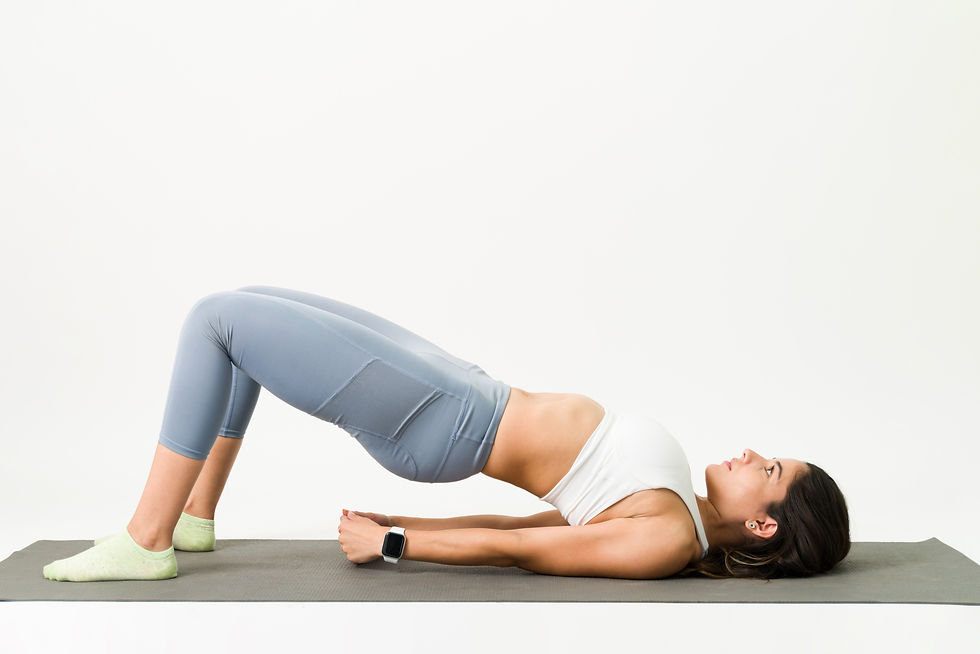
Common exercises include:
Clamshells
Side-lying hip abduction
Glute bridges
Stretching the iliotibial band reduces excessive tension that contributes to the lateral hip pain.
Gradual Return to Activity
As pain decreases and strength improves, functional activities and sport-specific tasks are reintroduced in a graded manner, ensuring that tendon load increases progressively and remains within tolerance.
Summary
Greater trochanteric pain syndrome (GTPS) is a condition of the muscles and tendons surrounding the hip bone. This condition is more prevalent in women due to their biomechanical and anatomical structure that is different from those of men. Symptoms often arise as a result of sudden or excessive activity on the gluteal tendons that are beyond their capacity. Typically, the gluteus medius and minimus muscles are weak, causing muscle imbalances and excessive stress on the gluteal tendons as well as the surrounding structures. Subsequently, tendon composition changes to a less organised type 2 and 3 collagen fibre structure, which makes the tendon weaker. This can sometimes lead to bursitis. By addressing strength, muscle imbalance and activity modification, tendons can gradually adapt and regain their capacity to tolerate activity. Effective treatment focuses on loading principles, a clinical model that aims to restore tendon health through progressive load. With a structured approach to GTPS, most individuals can achieve full recovery and return to pain-free activity.
References:
Fearon, A. M., Scarvell, J. M., Neeman, T., Cook, J. L., Cormick, W., & Smith, P. N. (2012). Greater trochanteric pain syndrome: Defining the clinical syndrome. British Journal of Sports Medicine, 46(9), 649–653. doi: 10.1136/bjsports-2012-091565
Grimaldi, A., Fearon, A., & Fearon, A. (2015). Gluteal tendinopathy: Integrating pathomechanics and clinical features in its management. Journal of Orthopaedic & Sports Physical Therapy, 45(11), 910–922. doi:10.2519/jospt.2015.5829
Grimaldi, A., Mellor, R., Hodges, P., Bennell, K., Wajswelner, H., & Vicenzino, B. (2015). Gluteal Tendinopathy: A Review of Mechanisms, Assessment and Management. Sports medicine (Auckland, N.Z.), 45(8), 1107–1119. doi: 10.1007/s40279-015-0336-5
Kjpargeter. (n.d.). 3D female medical figure with hip bone highlighted [Image]. Freepik. https://www.freepik.com/free-photo/3d-female-medical-figure-with-hip-bone-highlighted_1594720.htm
Mellor, R., Bennell, K., Grimaldi, A., Nicolson, P., Kasza, J., Hodges, P., & Vicenzino, B. (2018). Education plus exercise versus corticosteroid injection versus wait and see for gluteal tendinopathy: A prospective, single-blinded, randomised clinical trial. BMJ, 360, k1662. doi: 10.1136/bmj.k1662
Physiopedia. (n.d.). Greater trochanteric pain syndrome [Illustration]. Adapted from https://www.physio-pedia.com/Greater_Trochanteric_Pain_Syndrome
Pianka, M. A., Serino, J., DeFroda, S. F., & Bodendorfer, B. M. (2021). Greater trochanteric pain syndrome: Evaluation and management of a wide spectrum of pathology. SAGE Open Medicine, 9, 20503121211022582. doi:10.1177/20503121211022582
Pumarejo Gomez L, Li D, Childress JM. Greater Trochanteric Pain Syndrome (Greater Trochanteric Bursitis) (2024). In: StatPearls [Internet]. Treasure Island (FL): StatPearls Publishing; 2025. Available from: https://www.ncbi.nlm.nih.gov/books/NBK557433/
Reid, D. (2016). The management of greater trochanteric pain syndrome: A systematic literature review. Journal of Orthopaedics, 13(1), 15–28. doi: 10.1016/j.jor.2015.12.006
Semciw, A., Cook, J., Moreira, E., & Pizzari, T. (2018). Gluteal loading versus sham exercises to improve pain and dysfunction in postmenopausal women with greater trochanteric pain syndrome: A randomized controlled trial. Journal of Women’s Health, 27(6), 815–829. doi: 10.1089/jwh.2017.6684
Speers, C. J. B., & Bhogal, G. S. (2017). Greater trochanteric pain syndrome: A review of diagnosis and management in general practice. British Journal of General Practice, 67(663), 479–480. doi: 10.3399/bjgp17X692213
Tonodiaz (n.d.). focused young woman maintaining bridge pose active woman exercising her buttocks back muscles with yoga workout [Image]. Freepik. https://www.freepik.com/free-photo/focused-young-woman-maintaining-bridge-pose-active-woman-exercising-her-buttocks-back-muscles-with-yoga-workout_27508076.htm#fromView=search&page=1&position=1&uuid=bd6fd97c-b724-49b3-b0a6-7297ab35e098&query=glute+bridges
Assessed and Endorsed by the MedReport Medical Review Board


