Why Do Some People Never Get Cavities? The Hidden Biology of “Cavity Resistance”
Updated: Jul 22
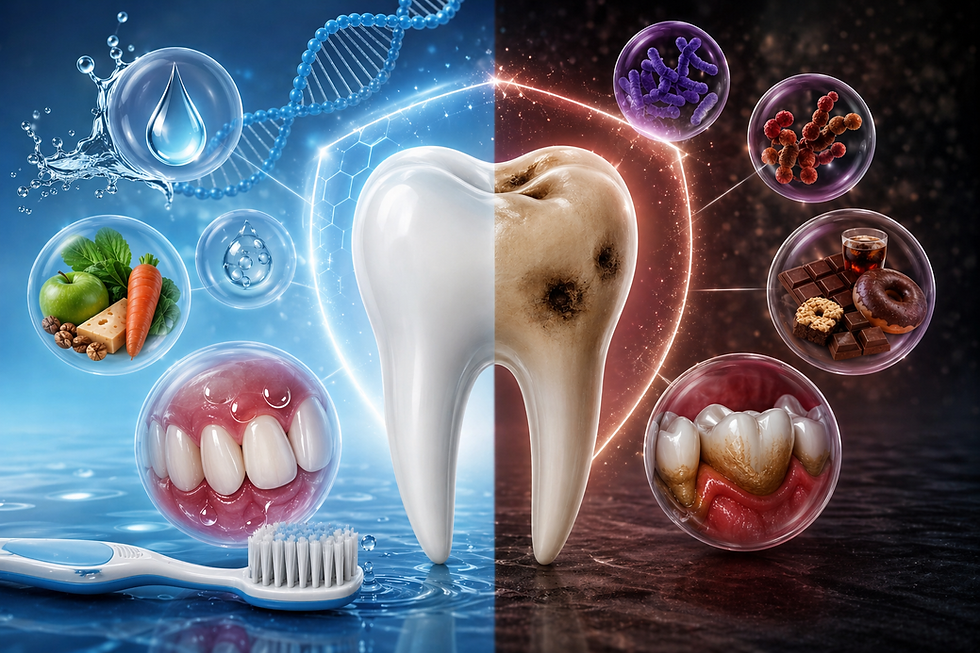
Why do some people seem to never get cavities, even with less-than-perfect habits, while others develop them despite regular brushing? Dental cavities, or tooth decay, are one of the most common oral health problems, yet their occurrence varies widely between individuals.
A cavity forms when acids produced by bacteria gradually damage the tooth structure. While brushing and diet are important, they do not tell the whole story. Factors such as genetics, saliva, oral bacteria, and daily habits all interact to influence a person’s risk.
This has led to the idea of “cavity resistance”. The natural ability of some individuals to resist tooth decay. Understanding the biology behind this can help explain these differences and highlight how cavity risk can be managed more effectively.
What Causes Cavities?
Dental plaque is a sticky film that forms on the surface of teeth. It is considered a biofilm, meaning a structured community of living microorganisms that develop when food particles, especially sugars and carbohydrates, remain on the teeth. These bacteria metabolize carbohydrates and produce acids as a byproduct. This acid lowers the pH in the mouth, creating an acidic environment.
When the pH drops below a critical level, the acid begins to dissolve the minerals present in the enamel and, if the process continues, the underlying dentin. This process is known as demineralization and is the primary step in the formation of dental caries (cavities). Over time, repeated acid attacks without adequate repair lead to permanent damage, resulting in cavities.
One of the key bacteria involved in this process is Streptococcus mutans, which is known for its ability to produce acid and thrive in low-pH environments.
However, the mouth also has natural protective mechanisms. After an acid attack, saliva helps neutralize the pH, gradually returning it toward normal. Saliva also contains essential minerals like calcium and phosphate, which help redeposit lost minerals back into the enamel. This repair process is called remineralization.
Thus, tooth decay is not a one-way process but a constant “tug of war” between demineralization and remineralization. Cavities develop when demineralization outweighs remineralization over time.
Cavity formation depends on several key factors like Bacteria, Diet, Time and Host factors. These factors vary from person to person, which explains differences in cavity risk. One of the most important factors influencing this process is the type and balance of bacteria present in the mouth. (1)
Role of the Oral Microbiome
The oral microbiome refers to the community of microorganisms that live in the mouth. It is highly diverse, with over 700 species of bacteria identified. Importantly, not all of these bacteria are harmful, many play a protective role in maintaining oral health.
In a healthy mouth, there is a balance between beneficial and harmful bacteria. Some beneficial bacteria help neutralize acids and support a stable pH, reducing the risk of enamel damage. Individuals with good oral health tend to have a more balanced microbial community.
In contrast, when acid-producing bacteria such as Streptococcus mutans become dominant often due to frequent sugar intake, the balance shifts. This leads to a more acidic environment that favours demineralization and increases the risk of cavities.
Therefore, cavity formation is not just about the presence of bacteria, but about the balance of the oral microbiome, which is strongly influenced by diet, especially the frequency of sugar and carbohydrate consumption. However, these differences in bacterial balance are not entirely random, genetic factors also play a role in shaping an individual’s risk. (2)
Genetics: How Your DNA Influences Cavity Risk
Genetics also plays an important role in cavity formation. It influences several key factors, including enamel development, saliva, and the oral microbiome. Genes such as ENAM and AMELX are involved in enamel formation. Mutations or variations in these genes can result in thinner or poorly mineralized enamel, making teeth more vulnerable to acid attack by bacteria.
Genetic factors also affect the characteristics of saliva, including its flow rate and composition. A good saliva flow helps wash away food particles, neutralize acids, and provide minerals that support remineralization, all of which help maintain a healthy oral environment.
In addition, genetics can influence the composition and behaviour of the oral microbiome. This means that some individuals may be more likely to harbour acid-producing bacteria, while others maintain a more balanced microbial environment that protects against decay.
Finally, genes that control tooth development can affect the structure of enamel and dentin. Disturbances in these processes may lead to softer or abnormally formed tooth structures, increasing the risk of cavities. However, it is important to note that genetics influences susceptibility, it does not determine outcomes, and good oral habits can significantly reduce risk. Along with genetics, another key factor that plays a protective role in the mouth is saliva. (3)
Saliva: The Mouth’s Natural Defense System
Saliva plays a key role in protecting teeth from cavities. It helps neutralize acids produced by bacteria, preventing damage to enamel, and washes away food particles and bacteria, reducing plaque buildup.
It also supports remineralization by supplying minerals like calcium and phosphate, which help repair early enamel damage.
Saliva varies between individuals. A higher flow rate and better composition provide stronger protection, while reduced saliva increases cavity risk. Salivary flow is influenced by multiple factors, including hydration, age, gender, and circadian rhythms.
Overall, effective saliva function is an important factor in natural “cavity resistance.” While saliva provides natural protection, everyday dietary habits can either support or disrupt this balance. (4)
Diet Patterns: More Than Just Sugar
Diet plays a major role in cavity formation, but it is not just about how much sugar is consumed, it is about how often and in what form it is consumed.
Frequent intake of sugars and refined carbohydrates leads to repeated acid production and prolonged low pH, increasing the risk of cavities. There is a clear dose–response relationship, where higher frequency means higher risk.
Eating patterns are important. Frequent snacking or sipping sugary drinks is more harmful than consuming sweets with meals, as it keeps the mouth in an acidic state.
Processed foods such as breads, cookies, cereals, and packaged snacks are more easily fermented and often contain hidden sugars.
In contrast, a balanced diet rich in vegetables, fiber, and whole foods is associated with lower cavity risk.
Early dietary habits also matter, as patterns formed in childhood can influence long-term risk.
In addition to diet, external protective factors such as fluoride further strengthen the teeth against decay. (5,6)
Fluoride: Strengthening Enamel Defense
Fluoride helps protect teeth by strengthening enamel and making it more resistant to acid attack. It promotes remineralization and reduces mineral loss, improving resistance to cavities.
Regular low-level exposure is most effective. Fluoride toothpaste can reduce cavities. It is also found in drinking water, salt, and foods from fluoridated areas.
Fluoride can also form temporary reservoirs in the mouth, providing a sustained protective effect. However, the effectiveness of these protective factors also depends on daily habits and behaviour. (7)
Lifestyle and Behavioural Factors
Lifestyle and daily habits play an important role in cavity risk. It is not just about whether oral hygiene is practiced, but how consistently and effectively it is done. Poor or irregular brushing can lead to visible plaque buildup, increasing the risk of decay.
Certain habits increase risk, such as frequent intake of sugary foods and beverages and unsupervised or ineffective brushing, especially in children. In contrast, consistent oral hygiene and reduced sugar exposure help protect against cavities.
Behavioral factors are also influenced by social and environmental conditions. Limited access to care, financial constraints, and challenging family situations can lead to neglected oral hygiene and unhealthy dietary habits. On the other hand, higher education levels, supportive family environments, and positive past dental experiences are associated with better oral health practices.
Overall, lifestyle and behavioral factors significantly influence “cavity resistance” by shaping daily habits and long-term oral health outcomes. (8)
Conclusion
Cavity formation is not caused by a single factor, but by the interaction of multiple biological and lifestyle influences. The balance between harmful and protective processes such as acid production and remineralization determines whether tooth decay develops.
Factors like enamel strength, saliva function, oral microbiome balance, diet, fluoride exposure, and daily habits all contribute to what is often described as “cavity resistance.” While some individuals may naturally have an advantage, no one is completely immune to cavities.
The good news is that many of these factors can be influenced through simple, consistent habits. By understanding how cavities develop and what protects against them, individuals can take more informed steps to maintain long-term oral health.
References:
1. Themes UFO. Pocket Dentistry [Internet]. 2020 [cited 2026 Apr 30]. The Disease: 2 Etiology and Pathogenesis of Caries. Available from: https://pocketdentistry.com/part-1-caries-science-6/
2. Sedghi L, DiMassa V, Harrington A, Lynch SV, Kapila YL. The oral microbiome: Role of key organisms and complex networks in oral health and disease. Periodontol 2000. 2021 Oct;87(1):107–31. doi:10.1111/prd.12393 PubMed PMID: 34463991; PubMed Central PMCID: PMC8457218.
3. Sharma D, Bhandary S. Role of Genetic Markers in Dental Caries: A Literature Review. Journal of Health and Allied Sciences NU. 2024 Jul;14(03):303–8. doi:10.1055/s-0043-1771387
4. Gupta M, Jaidka S, Jawa D, Gupta BD, Apurva S and. SALIVARY BIOMARKERS OF DENTAL CARIES - A REVIEW ARTICLE. International Journal of Advanced Research. 2024 Jun 24;12(06):1214–24. doi:10.21474/IJAR01/18986
5. Dimopoulou M, Antoniadou M, Amargianitakis M, Gortzi O, Androutsos O, Varzakas T. Nutritional Factors Associated with Dental Caries across the Lifespan: A Review. Applied Sciences. 2023 Dec 14;13(24):13254. doi:10.3390/app132413254
6. Feldens CA, Kramer PF, Vargas-Ferreira F. The Role of Diet and Oral Hygiene in Dental Caries. In: Coelho Leal S, Takeshita EM, editors. Pediatric Restorative Dentistry [Internet]. Cham: Springer International Publishing; 2019 [cited 2026 Apr 30]. p. 31–55. Available from: http://link.springer.com/10.1007/978-3-319-93426-6_4 doi:10.1007/978-3-319-93426-6_4
7. Mankar N, Kumbhare S, Nikhade P, Mahapatra J, Agrawal P. Role of Fluoride in Dentistry: A Narrative Review. Cureus. 2023 Dec;15(12):e50884. doi:10.7759/cureus.50884 PubMed PMID: 38249196; PubMed Central PMCID: PMC10799546.
8. Themes UFO. Pocket Dentistry [Internet]. 2017 [cited 2026 Apr 30]. 11: Caries Prevention. Available from: https://pocketdentistry.com/11-caries-prevention/
Assessed and Endorsed by the MedReport Medical Review Board