


Understanding Zika Virus: A Simple Guide
- MedReport Foundation
- 2 hours ago
- 3 min read

By: Pawan Krishna Murti

Zika virus is a disease caused by a virus that is mainly spread through the bite of infected mosquitoes, especially the Aedes aegypti mosquito. It was first identified in 1947 in Africa and later spread to Asia, the Pacific Islands, and the Americas. In recent years, it became a global public health concern due to large outbreaks, especially in Brazil between 2015 and 2016 (1, 2).
How Zika Spreads
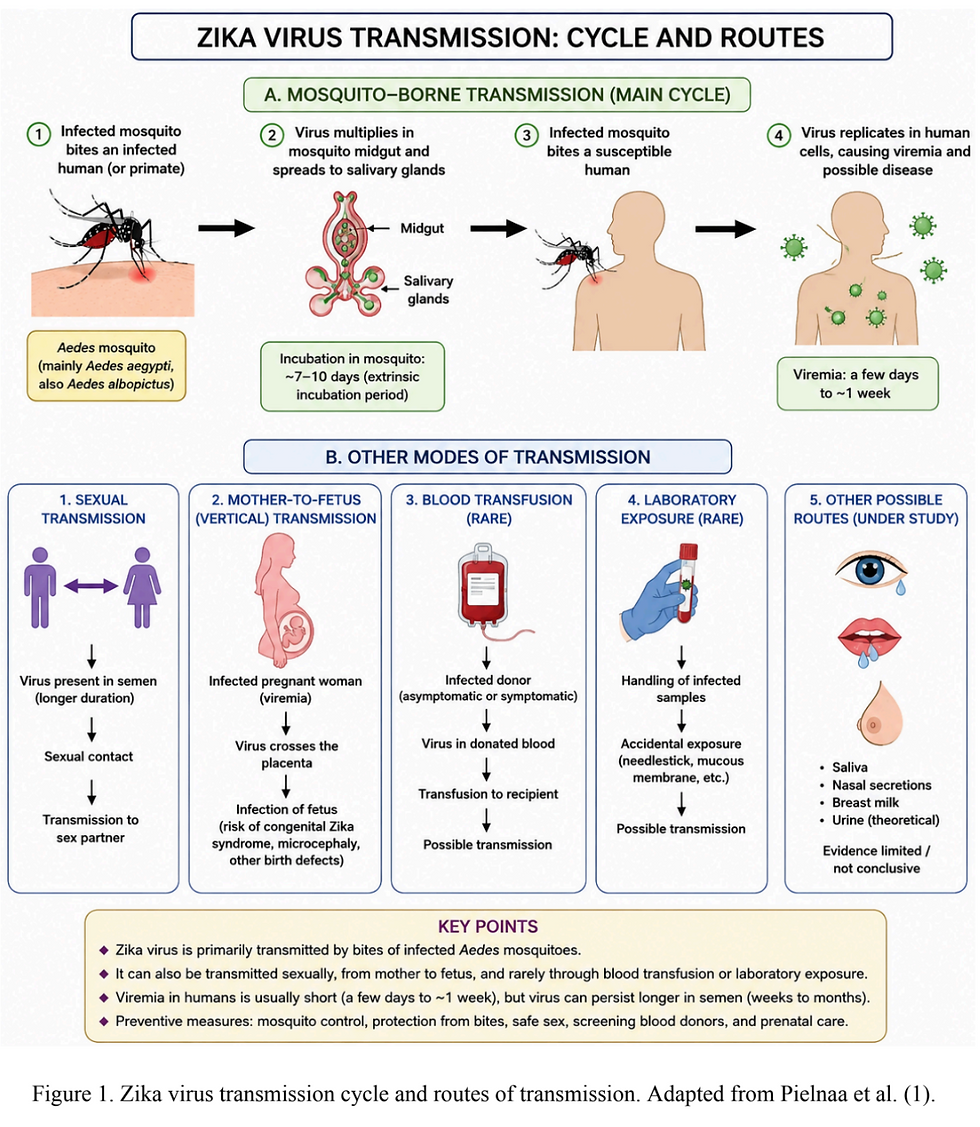
The most common way Zika spreads is through the bite of infected mosquitoes. When a mosquito bites a person who has Zika, it can carry the virus and pass it to another person through another bite.
However, Zika can also spread in other ways:
● From a pregnant mother to her baby during pregnancy
● Through sexual contact
● Through blood transfusion (rare cases)
Because of these multiple routes, the virus can spread quietly in communities (2).
Symptoms of Zika Virus
Many people infected with Zika do not feel sick at all. In fact, most infections are mild or unnoticed. When symptoms do appear, they are usually mild and last for a few days.
Common symptoms include:
● Mild fever
● Skin rash
● Red eyes (conjunctivitis)
● Joint and muscle pain
● Headache
● Weakness or fatigue
These symptoms are similar to other mosquito-borne diseases like dengue and chikungunya, so diagnosis can sometimes be difficult (1).
Why Zika Virus Is Important
Although most cases are mild, Zika virus is important because of its serious effects in certain groups, especially pregnant women. If a woman becomes infected during pregnancy, the virus can affect the developing baby and lead to birth defects such as:
● Microcephaly (small head size due to incomplete brain development)
● Brain damage
● Eye abnormalities
● Movement and developmental problems
In adults, Zika has also been linked to a rare neurological condition called Guillain-Barré syndrome, which can cause muscle weakness or paralysis.
Where Zika Is Found
Zika virus is mostly found in tropical and subtropical regions where mosquitoes live and breed easily. Major outbreaks have occurred in Africa, Asia, the Pacific Islands, and the Americas. At its peak, the virus spread to many countries worldwide, showing how quickly it can travel through global movement and mosquito populations.
Treatment
There is currently no specific medicine or vaccine for Zika virus. Most people recover on their own within a few days.
Treatment focuses on relieving symptoms:
● Rest
● Drinking plenty of fluids
● Pain and fever relief medicines (like paracetamol)
If dengue is suspected, aspirin and some anti-inflammatory drugs should be avoided.
Prevention
Prevention is the most important way to control Zika virus infection. Since there is no vaccine, protection against mosquito bites is essential:
● Use mosquito repellents
● Wear long-sleeved clothing
● Use mosquito nets or screens
● Remove standing water where mosquitoes breed
● Use protection during sexual contact if there is risk of infection
Pregnant women are advised to take extra precautions and avoid travel to high-risk areas when possible (1,3).
Future Concerns and Control
Even though major outbreaks have reduced in recent years, Zika virus still exists in many parts of the world.
The future risk depends on several factors:
● Climate change, which increases mosquito breeding areas
● Urbanization and crowded living conditions
● Global travel, which spreads infections quickly
Scientists are working on better tools such as vaccines, improved mosquito control methods, and early warning systems to prevent future outbreaks(4, 5).
Conclusion
Zika virus is usually a mild infection, but it can be serious during pregnancy and can lead to birth defects. Since there is no specific treatment, prevention through mosquito control and awareness is the best way to protect yourself and your community (1).
Reference:
1. Pielnaa P, Al-Saadawe M, Saro A, Dama MF, Zhou M, Huang Y, et al. Zika virus-spread, epidemiology,
genome, transmission cycle, clinical manifestation, associated challenges, vaccine and antiviral drug
development. Virology. 2020;543:34-42. Available from: https://doi.org/10.1016/j.virol.2020.02.007
2. Noorbakhsh F, Abdolmohammadi K, Fatahi Y, Dalili H, Rasoolinejad M, Rezaei F, et al. Zika virus
infection, basic and clinical aspects: a review article. Iran J Public Health. 2019;48(1):20-31.Available
3. McCain K, Vicco A, Morgenstern C, Rawson T, Naidoo TM, Bhatia S, et al. A systematic review and
meta-analysis of Zika virus epidemiology. Nat Health. 2026;1:355-367. doi:10.1038/s44360-025-00051-4.
Available from: https://www.nature.com/articles/s44360-025-00051-4.
4. Abrams, R.P.M., Solis, J., 2017. Therapeutic approaches for zika virus infection of the nervous system.
Neurotherapeutics 14 (4), 1027–1048. Available from: https://doi.org/10.1007/s13311-017-0575-2.
5. Saiz J-C, Martín-Acebes MA. (2017). The race to find antivirals for Zika virus. Antimicrob Agents
Chemother, 61( 6): e00411– 17. Available from : https://pubmed.ncbi.nlm.nih.gov/28348160/
Assessed and Endorsed by the MedReport Medical Review Board

