Squirrel Poop: A Time Capsule Beneath the Permafrost

At first, ancient squirrel poop may not sound like an important scientific discovery. However, frozen droppings from Arctic ground squirrels in the Yukon are giving researchers a surprisingly detailed look into ecosystems that existed up to 700,000 years ago. Preserved in deep permafrost, these droppings, called coprolites, contain ancient environmental DNA from plants, insects, microbes, and large Ice Age animals.

Researchers studied frozen ground squirrel burrows from the Yukon, an area that was once part of Beringia, the ancient land region connecting North America and Asia. Since the burrows stayed frozen and sealed for thousands of years, the DNA inside the fecal pellets was unusually well preserved. Scientists were able to recover genetic traces from woolly mammoths, horses, steppe bison, snowshoe hares, wolves, rodents, and even a large cat that may have been related to a cougar or the extinct American cheetah.
One reason these droppings are so useful is that Arctic ground squirrels behave like small collectors. Like modern ground squirrels, ancient ones likely gathered seeds, plants, bones, insects, and other materials into their burrows. Their feces therefore became accidental time capsules, preserving evidence of what they ate and what existed around them. This does not mean the squirrels were hunting mammoths or bison. Instead, the DNA may have come from plant material, insects, scavenged remains, or objects brought into the burrow.

The study also revealed new information about the squirrels themselves. Scientists found previously unknown genetic diversity among Arctic ground squirrels, including a lineage from about 700,000 years ago that no longer lives in the Yukon. Surprisingly, its closest living relatives are found today in western Siberia. This challenges the older assumption that Yukon ground squirrels remained mostly unchanged over time. Instead, the DNA suggests that climate change, migration, and environmental shifts shaped squirrel evolution across the Arctic.
Why This Discovery Matters
The discovery of ancient Arctic ground squirrel droppings is about much more than the squirrels themselves. The study highlights the growing importance of ancient DNA research, a field that is transforming scientists' understanding of the past. Advances in DNA sequencing technology now allow researchers to recover genetic information from fossils, sediments, and even feces. Similar techniques have been used to study woolly mammoths, Neanderthals, and other extinct organisms. By analyzing DNA preserved within squirrel coprolites, scientists were able to reconstruct entire ecosystems that existed hundreds of thousands of years ago, demonstrating how genetic evidence can reveal details that traditional fossils alone cannot provide.
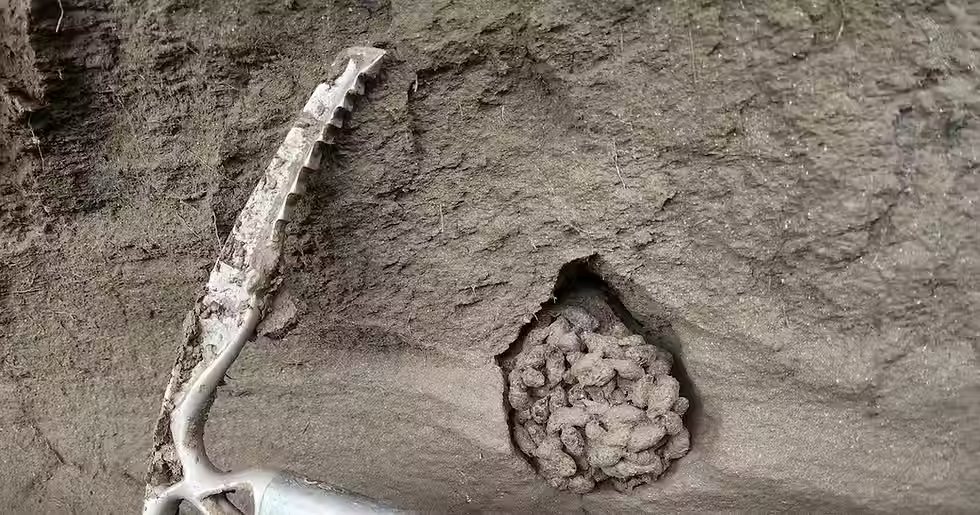
The findings are also relevant to modern climate change. The squirrel burrows and their contents were preserved because they remained frozen within Arctic permafrost for hundreds of thousands of years. However, rising global temperatures are causing permafrost to thaw at an accelerating rate. While thawing permafrost may expose new scientific discoveries, it also threatens to destroy valuable biological records before they can be studied. These ancient droppings serve as a reminder that the Arctic contains an extraordinary archive of Earth's history, one that is increasingly vulnerable to environmental change.
Perhaps most importantly, studies like this help scientists understand how ecosystems respond to changing climates over long periods of time. The Arctic has experienced multiple cycles of warming and cooling throughout its history, forcing species to adapt, migrate, or disappear. By examining which plants and animals lived together in the past, researchers can gain insight into how modern ecosystems may respond to the rapid environmental changes occurring today. In this way, ancient squirrel droppings provide not only a glimpse into the Ice Age, but also valuable clues about the future of Arctic biodiversity.

Conclusion
Overall, the research shows that permafrost can preserve more than fossils. It can protect genetic records of entire ecosystems. As Arctic regions warm and permafrost melts, discoveries like this may become both more possible and more urgent. Frozen squirrel poop may seem strange, but it is helping scientists understand how life responded to past climate changes—and how today’s ecosystems might respond to future ones.
By preserving DNA from plants, animals, and entire ecosystems, these ancient droppings are helping scientists reconstruct the past, understand the present, and better predict the future of a rapidly changing Arctic world.
References
Brookshire, B. (2026). Frozen squirrel poop hints at sights and smells of Ice Age ecosystems. Science News. https://www.sciencenews.org/article/frozen-squirrel-poop-ice-age-ecosystems
Lawlor, M. (2026). Ancient ground squirrel droppings reveal rich details about evolutionary history of the Arctic. McMaster News. https://news.mcmaster.ca/ancient-ground-squirrel-droppings-dating-back-700000-years-reveal-rich-details-about-evolutionary-history-of-the-arctic/
Thaler, P. (2026). Frozen squirrel poop rewrites rodent evolution, reveals new details about mammoths. Science. DOI: 10.1126/science.zjevnsc
Assessed and Endorsed by the MedReport Medical Review Board