Lactic Acid: An Emergent Property of the Body Under Stress

Anyone who has pushed through a hard workout has felt the burn associated with lactic acid.
What is less commonly understood is that lactic acid is not simply a chemical made by one organ or one type of cell. It is what biologists call an emergent property, a characteristic that arises only when several smaller components of a system interact, and that cannot be produced by any single part alone. Lactic acid production is a clear example of this concept, since it depends on the coordinated activity of skeletal muscle, red blood cells, and the liver working together as one system.
The Origins of Lactic Acid
Lactic acid, more precisely called lactate once it dissociates in the body, is a compound produced when cells break down glucose without using oxygen (2). During high-intensity exercise, the demand for energy in working muscles can outpace the rate at which oxygen is delivered to them. Rather than stopping energy production altogether, the muscle shifts from aerobic to anaerobic metabolism, a switch that allows contraction to continue even when oxygen becomes limited (3). This shift is not a flaw in the system. It is an adaptive response that keeps muscles supplied with just enough energy to sustain short bursts of intense effort.
The Chemical Pathway Behind Lactate Production
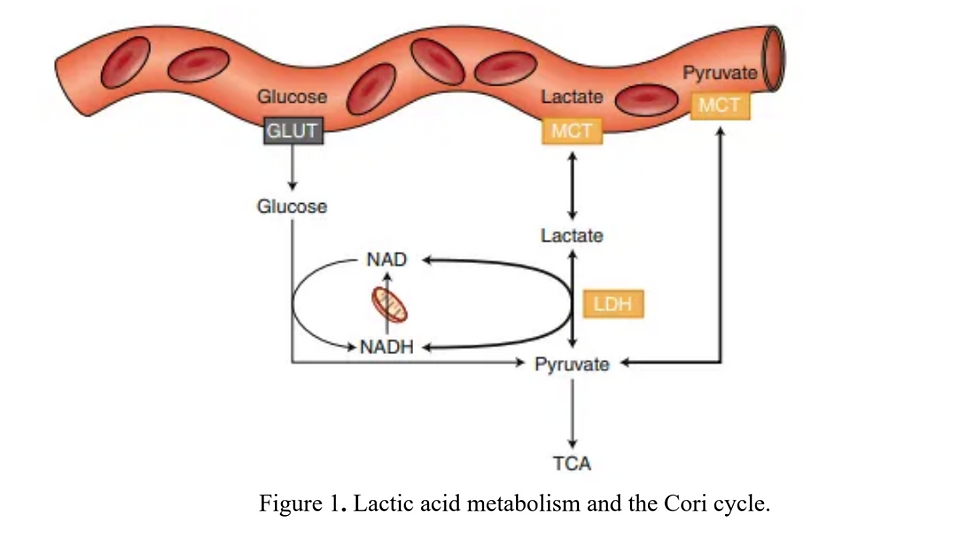
The process that produces lactate unfolds in stages. It begins with glycolysis, the pathway that breaks a single molecule of glucose into two molecules of pyruvate. This reaction yields a small amount of ATP, the molecule cells use as an immediate energy source, along with a compound called NADH (4). Under normal conditions, pyruvate would move into the mitochondria to be used in aerobic respiration. When oxygen is scarce, however, the mitochondria cannot keep up, and NADH cannot be recycled back into NAD+ quickly enough to keep glycolysis running (4). To solve this problem, the enzyme lactate dehydrogenase converts pyruvate into lactate, a reaction that regenerates NAD+ and allows glycolysis to continue independent of oxygen availability (5). Far from being a metabolic dead end, this reaction is now recognized as central to how the body sustains energy production and communicates metabolic status between tissues (6).
Skeletal Muscle as the Primary Site of Production
Skeletal muscle fibers are built for sustained, oxygen-dependent activity, but their structure also allows them to pivot rapidly toward anaerobic metabolism when demand outstrips supply. Glucose enters the muscle fiber through a transporter called GLUT4, is broken down through glycolysis, and, when oxygen is low, is converted to lactate by lactate dehydrogenase (7). Additional transport proteins, MCT1 and MCT4, then move that lactate out of the muscle fiber and into circulation. This entire sequence depends on the muscle cell's specific structure and its unusually high energy demand during exertion, which is precisely why skeletal muscle remains the primary source of lactate in the body during exercise (3,6).
Red Blood Cells as a Constant Source of Lactate
Red blood cells contribute to lactate production in a different way. Because mature red blood
cells lack mitochondria entirely, they cannot perform aerobic respiration under any
circumstances and must rely completely on glycolysis to generate their limited ATP supply (7). As a result, red blood cells produce lactate continuously, even when oxygen is abundant
elsewhere in the body. During intense exercise, this dynamic becomes especially important. Red blood cells are responsible for delivering oxygen to working muscles, and when that delivery cannot keep pace with demand, muscle tissue is pushed further into anaerobic metabolism, amplifying overall lactate output (7).
The Liver's Role in Completing the Cycle
Lactate produced by both muscle and red blood cells does not accumulate indefinitely. It travels through the bloodstream to the liver, where it is converted back into pyruvate and then into glucose through a process called gluconeogenesis, a pathway known as the Cori cycle (8). The liver can either release this newly formed glucose back into the bloodstream to fuel working muscles or store it as glycogen for later use (8). This step depends on the liver's distinct structural regions working in sequence, and it depends equally on the muscle and red blood cells having produced lactate in the first place. Without any one of these components, the cycle breaks down.
Conclusion
Lactic acid production is a textbook case of emergence in human physiology. No single enzyme, cell, or organ can produce and manage lactate on its own. It takes the combined action of muscle fibers switching metabolic pathways, red blood cells running continuous glycolysis, and the liver recycling lactate back into usable glucose for the process to function at all (4). Understanding lactic acid this way reframes it from a simple byproduct of "burning muscles" into a signal of how interconnected the body's systems truly are, working together to keep it moving even when oxygen runs short.
References
1. Metware Biotechnology Inc. Lactic acid: Key roles in human metabolism, diseases,
and health implications. Published August 15, 2024. Accessed July 14, 2026.
2. Lactic acid. Cleveland Clinic. Accessed July 14, 2026.
3. What is lactic acid? CMS Fitness Courses. Accessed July 14, 2026.
4. What is lactic acid? Osmosis from Elsevier. Accessed July 14, 2026.
5. Nelson DL, Cox MM. Lehninger Principles of Biochemistry. 4th ed. W.H. Freeman;
2005.
6. Vavřička J, Brož P, Follprecht D, Novák J, Kroužecký A. Modern perspective of
lactate metabolism. Physiol Res. 2024;73(4):499-514.
7. Anaerobic glycolysis. ScienceDirect Topics. Elsevier. Accessed July 14, 2026.
glycolysis
8. Cori cycle. The Blood Project. Accessed July 14, 2026.