Growing Cities? The Rise of Vertical Farming in Urban Landscapes

As global urbanization accelerates, cities are becoming the primary areas of human population growth, placing increasing pressure on traditional agricultural systems. Feeding dense urban populations sustainably is one of the defining challenges of the 21st century. In response, vertical farming, which is the cultivation of crops in vertically stacked layers within controlled indoor environments, has emerged as a transformative approach to food production. By integrating advances in agricultural science, engineering, and digital technology, vertical farming offers a compelling vision for the future of urban food systems.
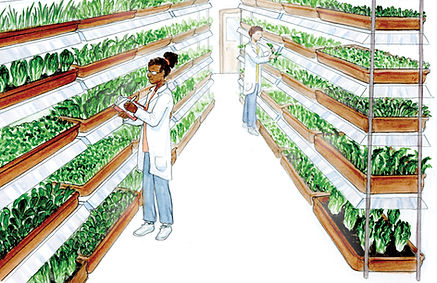
What is Vertical Farming?
Vertical farming is a form of controlled-environment agriculture (CEA) in which crops are grown indoors using systems such as hydroponics, aeroponics, or aquaponics, often without soil. These systems rely on precise control of environmental factors: light, temperature, humidity, and nutrients, to optimize plant growth.
Unlike traditional farming, which is constrained by land availability and climate, vertical farming allows crops to be cultivated in stacked layers within buildings, warehouses, or even shipping containers. This structure maximizes productivity per unit area, making it particularly suited for densely populated urban environments where cultivable land is scarce.
Advancements in Agriculture and Science
Controlled Environments and Precision Growth
One of the most significant scientific advancements underpinning vertical farming is the ability to engineer ideal growing conditions. Crops are cultivated in environments free from pests, extreme weather, and seasonal limitations, resulting in consistent yields and improved food safety.
Artificial Lighting and Plant Optimization
Modern vertical farms utilize energy-efficient LED lighting systems that deliver specific wavelengths of light optimized for photosynthesis. This allows crops to grow faster and more efficiently than in natural sunlight conditions.
Integration of Smart Technologies
Vertical farming is closely tied to the broader movement of “Agriculture 4.0,” incorporating technologies such as artificial intelligence, sensors, and automation. These systems monitor plant health, regulate nutrients, and optimize resource use in real time, significantly increasing efficiency and reducing waste.
Resource Efficiency Innovations
Compared to traditional agriculture, vertical farming systems can use dramatically less water, up to 90% less in some cases - due to closed-loop nutrient and irrigation systems.

Vertical Farming and Urbanization
Urbanization and vertical farming are deeply interconnected. As cities expand, agricultural land is lost, and food must travel longer distances to reach consumers. Vertical farming addresses these challenges by bringing food production directly into urban spaces, reducing reliance on rural farmland and long supply chains.
In urban environments, vertical farms can be integrated into buildings, rooftops, or unused infrastructure, transforming cities into partially self-sustaining ecosystems. This localized production reduces “food miles” and supports fresher, more accessible produce for urban populations.
Furthermore, vertical farming aligns with sustainable urban development goals by reducing land use pressure and minimizing environmental disruption, including habitat destruction associated with conventional agriculture.

Benefits of Vertical Farming
Increased Yield and Space Efficiency
Vertical farming dramatically increases productivity per unit area. Some systems can produce 10–20 times more yield per acre compared to traditional farming.
Year-Round Production
Because environmental conditions are controlled, crops can be grown continuously throughout the year, independent of seasonal changes.
Reduced Environmental Impact
- Lower water usage
- Minimal pesticide use
- Reduced land requirements
Improved Food Security
Vertical farming enhances urban food security by ensuring a consistent supply of fresh produce, even in regions where traditional farming is impractical due to climate or geography.
Limitations and Challenges
Despite its advantages, vertical farming is not without significant limitations.
High Energy Consumption
One of the most critical challenges is the energy demand required for artificial lighting, heating, and climate control. In many cases, energy use can outweigh environmental benefits if powered by non-renewable sources.
Economic Barriers
Vertical farms require substantial upfront investment, often exceeding millions of dollars for large-scale operations. This raises concerns about profitability and scalability, particularly in competitive food markets.
Crop Limitations
Currently, vertical farming is most economically viable for high-value crops such as leafy greens and herbs. Staple crops like wheat or corn are less suitable due to space and energy constraints.
Technological Dependence
Vertical farming relies heavily on advanced technologies, making it vulnerable to system failures, high maintenance costs, and the need for specialized expertise.
5. Sustainability Trade-offs
While vertical farming reduces land and water use, its sustainability depends heavily on energy sources. Without renewable energy integration, its carbon footprint may offset environmental benefits.

Conclusion
Vertical farming represents a powerful intersection of agriculture, technology, and urban development. It offers a promising solution to the challenges posed by rapid urbanization, enabling efficient, localized, and sustainable food production. Advances in controlled-environment agriculture, artificial intelligence, and resource management have transformed vertical farming from a futuristic concept into a rapidly growing reality.
However, its long-term success depends on overcoming key limitations; particularly high energy use, economic viability, and scalability. Rather than replacing traditional agriculture, vertical farming is best understood as a complementary system that can enhance resilience in global food networks.
As cities continue to expand, vertical farming may play a crucial role in shaping the future of sustainable urban living, provided its technological and environmental challenges are addressed thoughtfully and strategically.
References
Behm, S. (n.d.). Vertical farming is growing up | FCC. Www.fcc-Fac.ca. https://www.fcc-fac.ca/en/knowledge/vertical-farming-is-growing-up
Funk, B. (2024, January 9). What You Should Know About Vertical Farming. Eden Green Technology. https://www.edengreen.com/blog-collection/what-is-vertical-farming
Kluczkovski, A., Hadley, P., Yap, C., Ehgartner, U., Doherty, B., & Denby, K. (2025). Urban vertical farming: innovation for food security and social impact? Philosophical Transactions of the Royal Society B Biological Sciences, 380(1935). https://doi.org/10.1098/rstb.2024.0154
Ling, K.-S., & Altland, J. (2023, July 12). Vertical Farming – No Longer A Futuristic Concept : USDA ARS. Www.ars.usda.gov. https://www.ars.usda.gov/oc/utm/vertical-farming-no-longer-a-futuristic-concept/
Vertical Field. (2025). Verticalfield.com. https://www.verticalfield.com/blog/what-is-urban-farming
Assessed and Endorsed by the MedReport Medical Review Board