Check Your Heart


If you’ve ever felt your heart pounding after exercise or during a scary movie, you have probably noticed the beats come faster than they would when you are relaxed. While temporary elevation of heart rate (the speed of those thumps) is normal in a lot of situations, constantly high heart rate can indicate serious issues. Learn how to check your heart rate and take charge of your heart health (and make sure your smartwatch isn’t lying to you).
Even if you have a smartwatch that monitors your heart rate, it's a good idea to learn to check yourself in case the technology fails. This skill can also be used to help others in an emergency. Knowing if and how fast the heart is beating is vital information for first responders.
How to Find Your Heart Rate
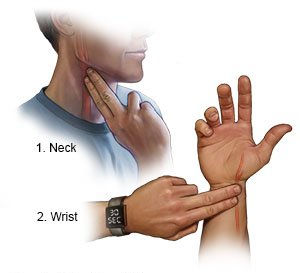
Step 1: Find your pulse.
The most common places to locate your own pulse are on the inside of your wrist just below the hand, and on your neck just below the jaw.
Step 2: Count beats and do some math
There are a variety of ways to count your heartbeats. The fastest is to count how many beats you feel in six seconds and add a zero (e.g. if you count 13 beats, your heart rate is 130). This is easier to do using an analog clock or watch. You can also count beats for a full minute, count beats for 10 seconds and multiply by six, or count for thirty seconds and double.
Normal Ranges and Exercise Goals
It’s that simple! Normal resting heart rate for adults is between 60 and 100 beats per minute. A resting heart rate a bit lower than 60 is a good sign you have a healthy cardiovascular system. If your resting heart rate is higher than 100 beats per minute, let your doctor know and start recording your pulse at about the same time every day. This will give your doctor helpful information to get you the right diagnosis and treatment.
Target heart rate for aerobic exercise (a.k.a. cardio) varies based on age, and is typically between 50 and 85% of your maximum safe heart rate. There are charts and calculators online to help you find a target heart rate, and some smartwatches can calculate and track the target for you during exercise. It is important to note that target heart rates are a guideline and you should listen to your body and your doctor. Don’t push beyond your limits trying to reach our goals.
References
https://www.facebook.com/Drugscom. How to Take A Pulse. Drugs.com. Published 2019. https://www.drugs.com/cg/how-to-take-a-pulse.html
American Heart Association. Target Heart Rates Chart. American Heart Association. Published August 12, 2024. https://www.heart.org/en/healthy-living/fitness/fitness-basics/target-heart-rates
Assessed and Endorsed by the MedReport Medical Review Board