


Balancing Brain Chemistry: The Essential Role of Antidepressants and Anxiolytics
Is There a Significant Need for Mental Health Medications?
Antidepressants and anxiolytics, or anti-anxiety, medications play significant roles in treating mental health conditions. As the prevalence of people with mental health conditions continues to stay high at over 1 in 5 U.S. adults, the need for these medications continues to be crucial. Based on a 2022 National Survey on Drug Use and Health conducted by the Substance Abuse and Mental Health Services Administration found that 59.3 million people, or 23.1% of the U.S. adult population live with a mental illness (National Institute of Mental Health, 2024). This consists of 2 categories, any mental illness (AMI) and serious mental illness (SMI). An AMI is defined as a mental, behavioral, or emotional disorder whose impact can vary from no impairment to mild, moderate, or even severe impairment. A SMI is a mental, behavioral, or emotional disorder resulting in serious functional impairment, which substantially interferes with or limits one or more major life activities. The survey found that females experienced higher rates of mental illness at 26.4% compared to their male counterparts at 19.7%. Additionally, young adults, or those aged 18-25, had the highest rates of AMI at 36.2% while those 50 and older had the lowest rates at 13.9% (National Institute of Mental Health, 2024). Looking more specifically at SMI rates, 6.0% of U.S. adults are impacted, an estimated 15.4 million people with the highest prevalence amongst young adults aged 18-25 at 11.6% (National Institute of Mental Health, 2024). Even more shocking is the rate of mental health disorders among adolescents, or those aged 13-18, with a prevalence of 49.5% having any mental disorder and 22.2% having a severe impairment (National Institute of Mental Health, 2024).
While there are nearly 60 million U.S. adults with some form of mental illness, only about 30 million of them (50.6%) received any form of treatment, which includes inpatient treatment and counseling, outpatient treatment and counseling, or the use of prescription medications (National Institute of Mental Health, 2024). When evaluating the 15.4 million people with a SMI in 2022, 10.2 million (66.7%) of them received mental health treatment within the year. While roughly half of affected individuals do not elect to receive any form of treatment, the other half do, with many of those utilizing prescription medications like antidepressants and anxiolytics.
How do Antidepressants and Anxiolytics Work?
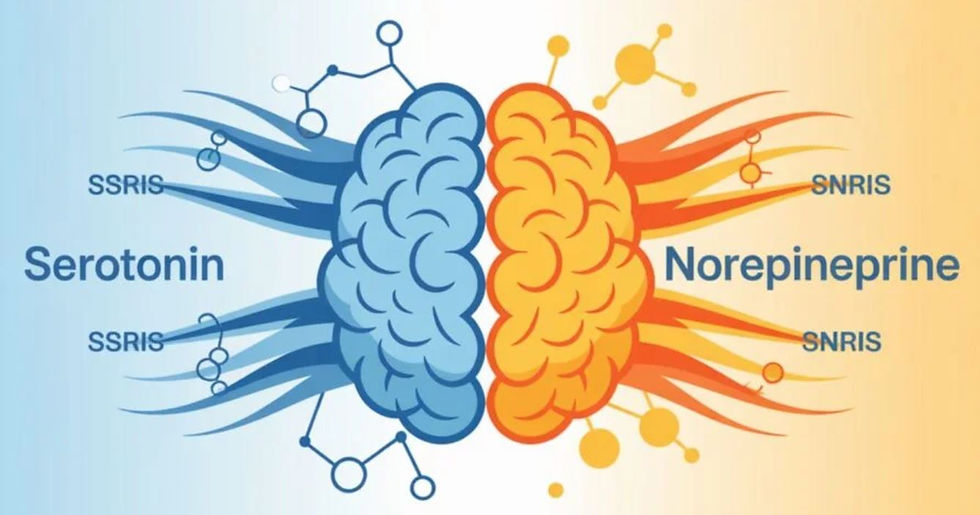
Antidepressant medications are generally used to treat depression; however, they can also help treat anxiety, PTSD, eating disorders, difficulty sleeping, and more. With depression being a condition that goes beyond general feelings of sadness and affecting one’s mood, thoughts, energy, and motivation. These medications fall under several different classes, each operating in their own way and used to treat varying mental health conditions. Two of the most prominent antidepressants are selective serotonin reuptake inhibitors (SSRIs) and serotonin-norepinephrine reuptake inhibitors (SNRIs). SSRIs work by raising the serotonin levels in the brain to help improve mood while SNRIs help raise both serotonin and norepinephrine levels which play roles in regulating mood, stress, and alertness (Cleveland Clinic, 2023b). Other types of antidepressants like tricyclic antidepressants, monoamine oxidase inhibitors, and atypical antidepressants all work in their own way to boost or alter brain chemicals in treating depression, PTSD, panic disorders, etc.
These medications work by changing the way the brain utilizes certain chemicals, called neurotransmitters, to help better regulate one’s mood and behavior. These neurotransmitters are the chemical messengers that neurons use to communicate signals throughout the brain and body. When one is impacted by depression, panic disorders, PTSD, etc. these pathways are often disrupted with the key neurotransmitters of serotonin, norepinephrine, and dopamine affected. Antidepressants operate by preventing these neurotransmitters from breaking down, allowing them to bind more effectively to receptors of the receiving neuron. With more neurotransmitters reaching the next neuron, the chemical signal that is sent throughout the body is made stronger. When antidepressants are used for prolonged periods of time, neuroplastic changes, or the brain's ability to reorganize and rewire neural connections, can be formed strengthening neuronal connections and promoting improved communication between various regions of the brain (Trifu et al., 2020).
Anxiolytics are generally used to treat anxiety, including panic attacks and extreme fear or worry. SSRI and SNRI medications can often be used in treating anxiety, as in the cases of panic disorders or social anxiety disorders. However, there is a strong class of anti-anxiety medications called Benzodiazepines that are most often used to treat short-term anxiety symptoms and conditions like generalized anxiety disorder. Generally, these medications can work in several different ways including either increasing or decreasing specific cell activity or slowing the reabsorption of neurotransmitters. Benzodiazepines, nonbenzodiazepines and barbiturates are medications that increase cell activity by activating a neurotransmitter called GABA that the body uses to reduce nervous system activity, and in turn helping reduce anxiety (Cleveland Clinic, 2023a). Beta-blockers are often used to decrease cell activity by slowing down the sympathetic nervous system which triggers the flight-or-fight response in people. Lastly, similar to what many antidepressants do, several classes of anxiolytics slow the reabsorption of neurotransmitters allowing for stronger ‘good’ signals to be passed around the body.
What are Common Side Effects or Problems with Taking Antidepressants and Anxiolytics?
Each type of medication has its own list of possible side effects. Among antidepressants, common side effects can include blurred vision, dizziness, headache, dry mouth, mood changes, nausea, tremors, changes in sodium levels, and more (Cleveland Clinic, 2023b). More serious complications can arise and medical consultation should be requested and consulted. In individuals under the age of 24, antidepressants may actually increase thoughts of suicide or self-harm, especially when changing or starting a new dose. Discontinuation syndrome can occur when antidepressants are stopped too quickly and can cause flu-like symptoms, trouble sleeping, dizziness, and mood changes while serotonin syndrome can cause too much serotonin to be present in the body and cause confusion, muscle stiffness, fever, or seizures (Cleveland Clinic, 2023b). Before and while taking antidepressants, medical professionals should be consulted and if any negative changes or side effects arise, it is important to contact your provider for additional support.
Anxiolytic medications have many of the same side effects of dizziness, sleepiness, and more yet may also cause organ complications, such as the use of beta-blockers. One important piece to note is the high addiction potential of benzodiazepine medications. This class of medications tend to be highly controlled and regulated yet still have the potential for misuse and addiction if continued for too long without regular provider reviews for appropriateness. To avoid these problems, health care providers usually prescribe benzodiazepines for short periods of time and taper them slowly to reduce the likelihood of withdrawal symptoms or renewed anxiety symptoms.
References:
Cleveland Clinic. (2023a). Anxiolytics and you: How anxiety medications can help. Cleveland Clinic. https://my.clevelandclinic.org/health/treatments/24776-anxiolytics
Cleveland Clinic. (2023b, March 1). Antidepressants. Cleveland Clinic; Cleveland Clinic. https://my.clevelandclinic.org/health/treatments/9301-antidepressants-depression-medication
National Institute of Mental Health. (2023). Mental Health Medications. National Institute of Mental Health. https://www.nimh.nih.gov/health/topics/mental-health-medications
National Institute of Mental Health. (2024, September). Mental Illness. National Institute of Mental Health. https://www.nimh.nih.gov/health/statistics/mental-illness
Trifu, S. C., Trifu, A. C., Aluaş, E., Tătaru, M. A., & Costea, R. V. (2020). Brain changes in depression. Romanian Journal of Morphology and Embryology, 61(2), 361–370. https://doi.org/10.47162/rjme.61.2.06
Assessed and Endorsed by the MedReport Medical Review Board

