


Activation of the Mesolimbic Pathway: What Happens When We Eat Sugar?
- poornimasurve26
- May 5
- 6 min read
Introduction
Why does a slice of cake feel so satisfying even when we are hungry? Beyond taste, beyond calories, beyond sweetness, sugar activates a network in the brain structure known as the mesolimbic pathway. When we eat sugar, this system releases dopamine, reinforcing behaviours the brain interprets as rewarding. While this response is a part of normal human physiology, the frequency and intensity with which it is stimulated in modern dietary environments is historically unmatched. To understand this, it is important to examine what drives sugar to stimulate peculiar patterns at the neurobiological levels.
The Brain’s Reward Circuitry
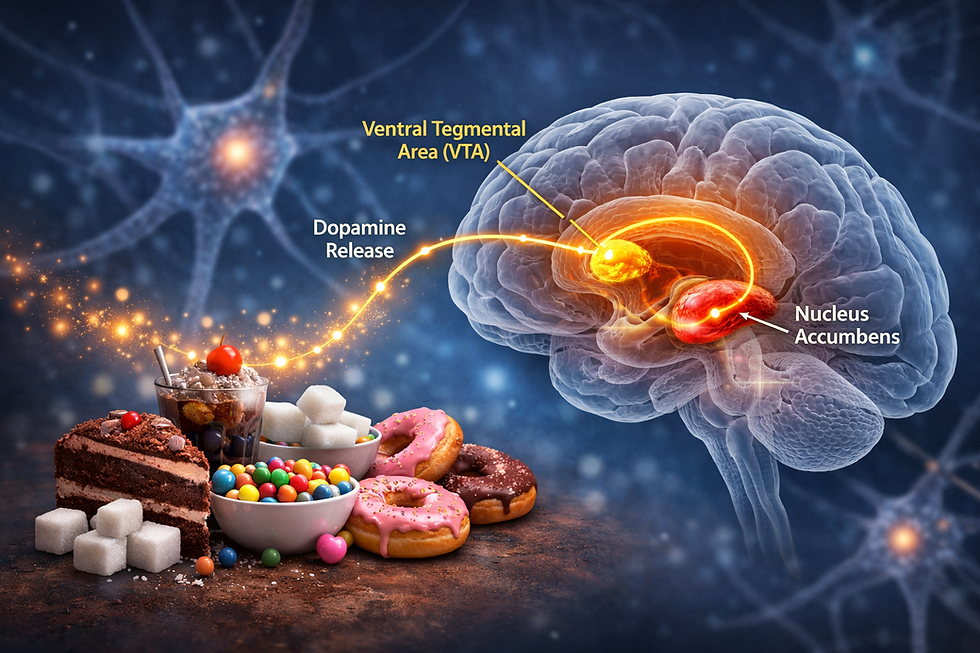
The mesolimbic pathway can be defined as a neural pathway that is involved mostly in the reward loop and emotional mediation by carrying dopamine from ventral tegmental area (VTA) to the nucleus accumbens, amygdala, and hippocampus in the brain. [1, 2, 3] The nucleus accumbens plays a central role in the feeling of pleasure. [4] It receives dopaminergic inputs, and it is believed that when this becomes excessive, it develops patterns of addiction. [4, 5] When we consume sugar, dopamine is released, giving us the feeling of pleasure and satisfaction.
It is important to know that the mesolimbic pathway has evolved to keep us alive. In environments where food was scarce and unpredictable – for example, many centuries ago – humans would come across ripe fruits and honey triggering dopamine release within the mesolimbic pathway.
Dopamine is also central to other cognitive functions like motivation and learning. The degree of motivation is directly proportionate to the levels of dopamine, as this hormone improves motor control that gets reflected into motivation through activities socialising and eating. [6, 7] It also facilitates reward-based learning that is generally related to demand of necessities like water and food and punishment-based learning. [7, 8]
In evolutionary terms, the brain has strongly linked the dopamine-releasing foods with location, context and sensory cues, and improved survival by activating behaviours that keep seeking that food.
Importantly, the system assumes scarcity, not constant availability. In modern food environments, where refined sugar is inexpensive and hardly noticeable, the same pathway is activated far more frequently that the evolution needed.
What Happens When We Consume Sugar?
Sugar enters the body and is broken down by the gastrointestinal system into simple sugars such as glucose and fructose. Glucose is absorbed into the bloodstream in the small intestine and is then transported to different parts of the body, such as the liver and pancreas. This process triggers pancreatic cells to produce insulin in order to regulate blood sugar levels. In cases of excess glucose, it is stored in the body as glycogen and fat, which are later utilized when the body’s energy levels are depleted. Excess fructose can lead to overload in the liver and intestines and may also impair insulin function, increasing the risk of diabetes and obesity. [9, 10, 11, 12]
Simultaneously, dopamine is released in the brain’s reward centers. This triggers reinforcement learning, and the brain tags sugar-induced dopamine release as valuable. Ultimately, repeated exposure to sugar strengthens the cue-reward association and leads to cravings and persistent sugary food–seeking behavior. [12, 13] This creates a loop commonly referred to as “sugar addiction.” It contributes to various issues such as weight gain, diabetes, and neurological problems. Excess sugar consumption can also lead to skin aging, as proteins that protect the skin, such as collagen, become damaged. [14, 15] Chronic stress is also known to cause imbalances in blood sugar levels and insulin resistance, which may increase the risk of diabetes. [16]
Modern Food Environment
In the modern world, the availability of sugary foods has increased significantly, with numerous varieties now accessible. Studies suggest that people, especially adolescents, are widely exposed to creative food advertising and promotional strategies. This directly influences dietary choices and encourages the younger generation to seek attractive and palatable foods without proper knowledge of their health effects. [17] Moreover, the availability and affordability of ultra-processed and sugary foods have increased, making them extremely convenient to consume. [18] Importantly, the modern food environment’s constant stimulation is a major concern, as it creates conditions that allow the previously discussed factors to thrive.
Is It actually “Addiction”?
The term “sugar addiction” is still debated because many researchers believe that it may distract the public from a proper understanding of excessive sugar intake and its associated problems. [19] However, it is widely accepted that excessive sugar consumption can lead to addiction-like behaviors. This is because narcotic substances also activate the mesolimbic pathway through dopaminergic neurons, producing feelings of reward and motivation. [20, 21, 22] However, it is important to recognize that habit reinforcement plays a central role in this process, rather than moral weakness.
Conclusion
Sugar does more than just provide energy – it activates brain circuits that evolved to help humans survive. When we eat sugar, the mesolimbic dopamine pathway reinforces behaviours that the brain interprets as rewarding, increasing the likelihood that we will seek those foods again. In the past, when sweet foods were rare, this system helped humans prioritise valuable energy sources such as fruit or honey. Today, however, refined sugars are widely available and consumed far more frequently than our biology originally adapted for. Understanding how the brain responds to sugar helps explain why cravings can feel so strong and why eating behaviour is influenced not only by willpower, but also by the interaction between biology and our modern food environment.
References
Sahar Swidan, Bennett M. Advanced Therapeutics in Pain Medicine [Internet]. CRC Press eBooks. Informa; 2020 [cited 2026 Mar 1]. Available from: https://www.taylorfrancis.com/books/edit/10.1201/9780429504891/advanced-therapeutics-pain-medicine-sahar-swidan-matthew-bennett
Blaess S. Mesolimbic Pathway - an overview | ScienceDirect Topics [Internet]. Sciencedirect.com. 2013 [cited 2026 Mar 1]. Available from: https://www.sciencedirect.com/topics/neuroscience/mesolimbic-pathway
Mesolimbic pathway - definition — Neuroscientifically Challenged. Neuroscientifically Challenged [Internet]. Neuroscientifically Challenged. 2019 [cited 2026 Mar 1]. Available from: https://neuroscientificallychallenged.com/glossary/mesolimbic-pathway
Mohammad Navid Ebrahimi, Banazadeh M, Zahra Alitaneh, Ali Jaafari Suha, Esmaeili A, Behnam Hasannejad-Asl, et al. The distribution of neurotransmitters in the brain circuitry: mesolimbic pathway and addiction. Physiology & Behavior [Internet]. 2024 Jul 1 [cited 2026 Mar 1];284:114639–9. Available from: https://www.sciencedirect.com/science/article/abs/pii/S0031938424001847
Baik JH. Stress and the Dopaminergic Reward System. Experimental & Molecular Medicine [Internet]. 2020 Dec [cited 2026 Mar 1];52(12):1879–90. Available from: https://www.nature.com/articles/s12276-020-00532-4
Wise RA, Jordan CJ. Dopamine, behavior, and addiction. Journal of Biomedical Science [Internet]. 2021 [cited 2026 Mar 2];28(1). Available from: https://link.gale.com/apps/doc/A686404982/AONE?u=ko_k12hs_d24&sid=bookmark-AONE&xid=49e74636
Costa KM, Schoenbaum G. Dopamine. Current Biology [Internet]. 2022 Aug 8 [cited 2026 Mar 2];32(15):R817–24. Available from: https://www.sciencedirect.com/science/article/pii/S0960982222010223#:~:text=%28A%29%20Dopamine%20is%20derived%20from%20DOPA%2C%20itself%20derived
Yagishita S. Transient and sustained effects of dopamine and serotonin signaling in motivation‐related behavior. Psychiatry and Clinical Neurosciences [Internet]. 2019 Oct 23 [cited 2026 Mar 2];74(2):91–8. Available from: https://onlinelibrary.wiley.com/doi/full/10.1111/pcn.12942
PMC E. Blood Glucose Monitoring [Internet]. europepmc.org. 2020 [cited 2026 Mar 2]. Available from: https://europepmc.org/article/NBK/nbk555976
Hantzidiamantis PJ, Lappin SL, Awosika AO. Physiology, glucose [Internet]. PubMed. Treasure Island (FL): StatPearls Publishing; 2024 [cited 2026 Mar 2]. Available from: https://www.ncbi.nlm.nih.gov/books/NBK545201/
Tappy L. Metabolism of sugars: A window to the regulation of glucose and lipid homeostasis by splanchnic organs. Clinical Nutrition [Internet]. 2021 Apr [cited 2026 Mar 2];40(4):1691–8. Available from: https://www.sciencedirect.com/science/article/pii/S026156142030697X
Hartmann H, Pauli LK, Janssen LK, Huhn S, Ceglarek U, Horstmann A. Preliminary evidence for an association between intake of high‐fat high‐sugar diet, variations in peripheral dopamine precursor availability and dopamine‐dependent cognition in humans. Journal of Neuroendocrinology [Internet]. 2020 Dec [cited 2026 Mar 2];32(12). Available from: https://onlinelibrary.wiley.com/doi/full/10.1111/jne.12917
Qin D, Qi J, Shi F, Guo Z, Li H. Sugar Addiction: Neural Mechanisms and Health Implications. Brain and Behavior [Internet]. 2025 Jul [cited 2026 Mar 3];15(7). Available from: https://onlinelibrary.wiley.com/doi/full/10.1002/brb3.70338
Liang S. Why Do We Love Sugar and Sweets? [Internet]. Imperial Bioscience Review. 2021 [cited 2026 Mar 4]. Available from: https://imperialbiosciencereview.wordpress.com/2021/07/09/why-do-we-love-sugar-and-sweets/
Wang ST, Neo BH, Betts RJ. Glycosaminoglycans: Sweet as Sugar Targets for Topical Skin Anti-Aging. Clinical, Cosmetic and Investigational Dermatology [Internet]. 2021 Sep [cited 2026 Mar 4];Volume 14:1227–46. Available from: https://www.tandfonline.com/doi/full/10.2147/CCID.S328671
Sharma K, Akre S, Chakole S, Wanjari MB. Stress-Induced diabetes: A review. Cureus [Internet]. 2022 Sep 13 [cited 2026 Mar 4];14(9):e29142. Available from: https://www.ncbi.nlm.nih.gov/pmc/articles/PMC9561544/
Neufeld LM, Andrade EB, Suleiman AB, Barker M, Beal T, Blum LS, et al. Food choice in transition: adolescent autonomy, agency, and the food environment. The Lancet [Internet]. 2021 Nov 29 [cited 2026 Mar 5];399(10320). Available from: https://www.thelancet.com/journals/lancet/article/PIIS0140-6736(21)01687-1/fulltext
Pineda E, Stockton J, Scholes S, Lassale C, Mindell JS. Food environment and obesity: a systematic review and meta-analysis. BMJ nutrition, prevention & health [Internet]. 2024 Apr 22 [cited 2026 Mar 5];7(1):e000663–3. Available from: https://nutrition.bmj.com/content/early/2024/04/21/bmjnph-2023-000663
Greenberg D, St. Peter JV. Sugars and Sweet Taste: Addictive or Rewarding? International Journal of Environmental Research and Public Health [Internet]. 2021 Sep 17 [cited 2026 Mar 5];18(18):9791. Available from: https://www.mdpi.com/1660-4601/18/18/9791
Wei S, Hertle S, Spanagel R, Bilbao A. Female mice are more prone to develop an addictive-like phenotype for sugar consumption. Scientific Reports [Internet]. 2021 Apr 1 [cited 2026 Mar 5];11(1):7364. Available from: https://www.nature.com/articles/s41598-021-86797-9
Cardona-Acosta AM, Bolaños-Guzmán CA. Role of the mesolimbic dopamine pathway in the antidepressant effects of ketamine. Neuropharmacology [Internet]. 2023 Mar 1 [cited 2026 Mar 5];225:109374. Available from: https://www.sciencedirect.com/science/article/pii/S0028390822004336?via%3Dihub
Atar A. Neurobiological Consequences of High-Fat High-Sugar Diets on the Mesocorticolimbic System: a Narrative Review. Current Nutrition Reports [Internet]. 2026 Jan 16 [cited 2026 Mar 5];15(1). Available from: https://pmc.ncbi.nlm.nih.gov/articles/PMC12811340/
Assessed and Endorsed by the MedReport Medical Review Board


